Since the Significant Bank Database now includes data on cash flow statement items, we can take a closer look at the operating cash flows of European banks. Net operating cash flow is an important indicator of how much cash banks generate from their core operations, and a positive figure is generally preferable.
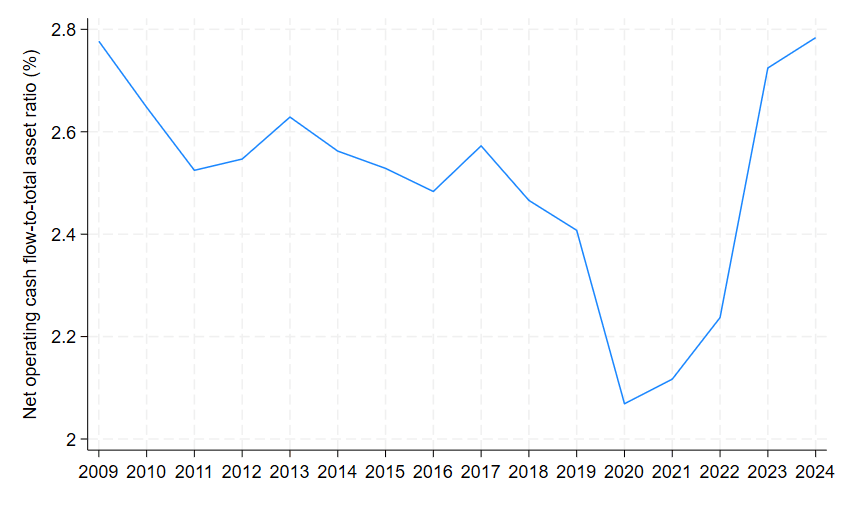
The figure below shows the annual development of the net operating cash flow-to-total assets ratio, expressed as a percentage. The trend is visible: the ratio has generally declined since 2009, reaching its lowest point during the COVID-19 crisis in 2020. The impact of the rapid rise in interest rates is also visible in the data. Between 2022 and 2023, net operating cash flow increased sharply. European banks’ operating cash flow relative to total assets remained at a high level in 2024.
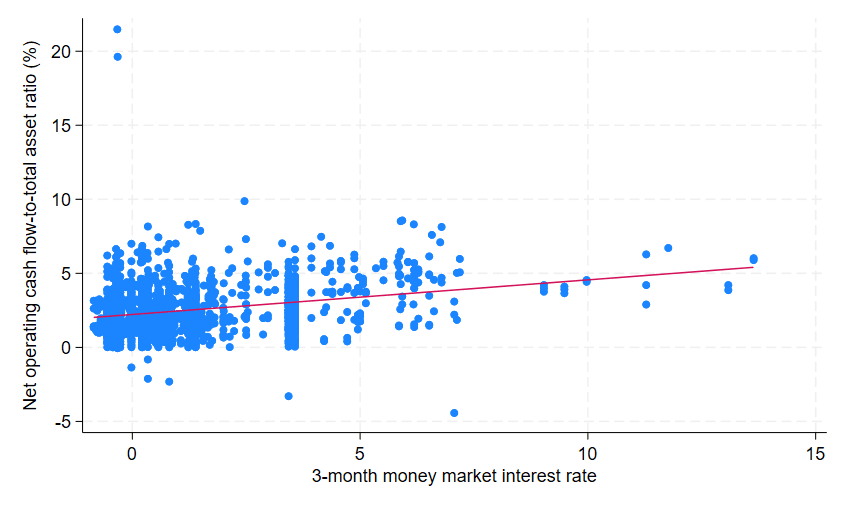
The next figure looks at the relationship between the short-term interest rate and the net operating cash flow-to-total assets ratio. Both variables are expressed as percentages. A clear positive relationship emerges: the higher the money market interest rate, the higher the net operating cash flow. The figure also shows that the ratio can occasionally be negative, although such cases are relatively rare.
There are, however, some notable outliers in the interest rate variable. In 2023, Hungary’s money market interest rate was close to 14 percent, which is the highest in the dataset. The reason for this exceptionally high rate is fairly straightforward: annual inflation in Hungary exceeded 17 percent that year.
Which bank had the highest net operating cash flow-to-total asset rate in 2024? It was 365.bank from Slovakia! In this post, we identified the most profitable banks in Europe in 2024. Interestingly, despite its strong operating cash flow, 365.bank did not make the TOP 10. This could indicate that the bank invested a significant portion of its cash flow in 2024. We’ll leave that analysis for another post.
We measured cash flow relative to year-end total assets. An alternative measure would be to use the average of total assets at the beginning and end of the year, which might lead to somewhat different results. This is just one of the many analyses that can be conducted using the Significant Bank Database!